
Linear
Holes with linear fairways are one of the most common styles to be found on golf courses. The fairway flows in a straight line between the tee and the green and provides you with a clear view of the entire hole. Although at first appearance it seems that a shot down the middle of the fairway would be ideal, one side of the fairway will generally provide a preferred angle of attack to the pin, depending on its position and the location of any hazards around the green.
Mentally play the hole backward because the pin location will dictate which side of the fairway provides the best angle of approach.
If the pin is positioned to the right behind a large bunker, the left side of the fairway is a better place from which to attack. If the pin is on the left side of the green, the right side will afford you the best opportunity for success.
Dog Leg Holes
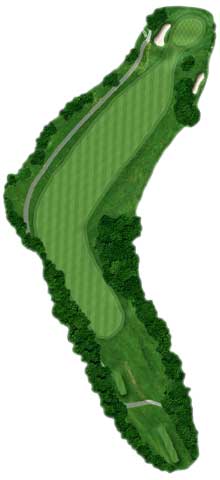
As courses were built inland and trees became part of the strategic challenge, designers bent holes to hide the final target. These became dog leg holes. You can expect to see three or four dog leg holes in a round.
The dog leg creates uncertainty about the landing area off the tee because you can’t see it or the preferred route to the green which is also hidden.
On a par 5 hole you may sometimes see a double dog leg. Where the hole bends again towards the green. The fairway will bend in two different directions. Holes of this kind require careful thought and planning because most golfers need at least two shots to set up the approach to the green.
Ask yourself these questions on a dog leg:
- What line should I take to shorten the hole?
- Is it worth the risk to cut the dog leg?
- How much landing area do I have beyond the corner of the dog leg?
- Can I hit through the dog leg?
Corridor holes
Routing the course through thick forests of trees provides a perceptual challenge for the golfer. The course designer will use the trees to defend against misdirected or poorly struck shots. These are major obstacles and you should take all efforts to avoid the woods.
Split holes
These are holes where the fairway is separated into sections by inserting a hazard such as a lateral water hazard or ditch or burn in between them or by creating an elevation change.
Where the fairway is split into two sections on the same horizontal plane the sections are divided by bunkers, rough or water hazards. One fairway segment will offer the best position from which to attack the hole but reaching it may involve greater risk. The safer option will result in a longer, more difficult route to the target. The area that separates these two fairways generally penalises you depending on the type and design of the hazard.
The second type is a fairway split into two elevations with or without a hazard or obstacle dividing it. The elevations are tied together by severe slopes. This design is more forgiving than the first type because there is a larger landing area but one side has a better angle of attack to the target.
You have to think about the route you are going to take. What will give you an advantage on this hole. Be decisive.
Island holes
Island fairways provide a distinct challenge. They usually have severe penalties on their perimeters meaning that an errant tee shot will end up in a hazard. They need you to hit the ball a certain distance to the prime landing area, so club selection is paramount. Know the distance to the furthest edge and choose the right club – know your own distances from your work on the practice ground.

