

Sometimes bunkers can be a better option to recover from an errant shot than playing out of the rough. From the sand you can control the ball more easily and have a better chance to save par.
The more you practice in bunkers and work on your technique the less worried you will be landing the ball in the sand.
Course designers use bunkers aesthetically to contrast against the green landscape as well as a shot making challenge. They are part of the strategy in the routing of a course. Some courses can have as many as 100 bunkers to make sure there is plenty of risk reward. But more doesn’t mean more difficult. It depends on where they are positioned.
Augusta National has 44 bunkers, but it has strategically placed creeks and water hazards. They are balanced with other challenges.
Types of Bunkers
A carry bunker is a flat, low bunker which protrudes out into the fairway and normally allows golfers to directly carry it. It is usually positioned short of the preferred landing area and is easily carried. They are usually easy to get out of due to the flat lies. Often carry bunkers are found in the corner of a dog leg hole.
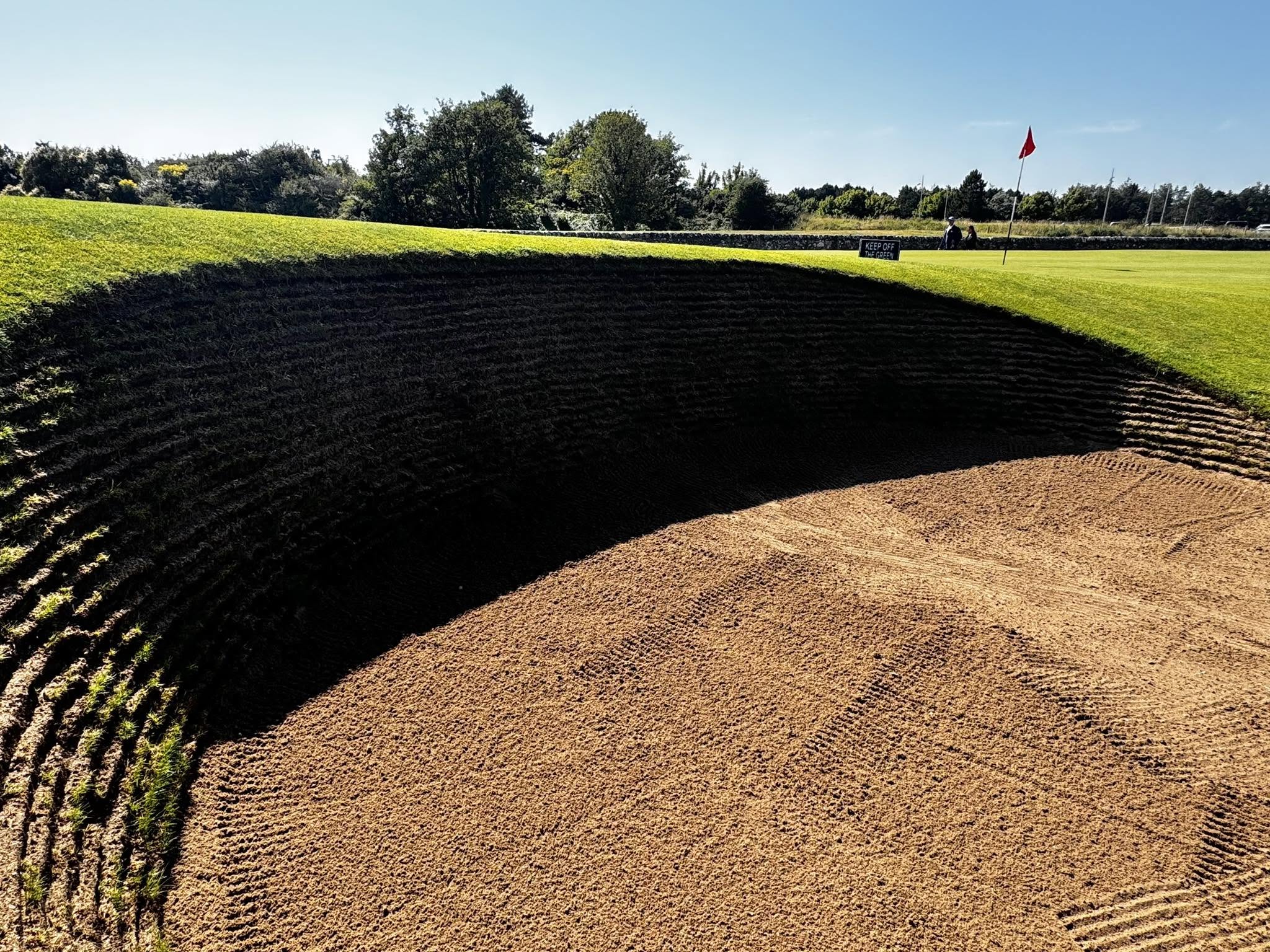
A collection bunker gets its character from the ground surrounding it which is sculpted to channel the ball into the bunker. Sometimes these bunkers can be deep and big with a high front wall. They force you to play backwards or sideways to recover the shot. The monster hole on the 4th at Royal St Georges is a collection bunker. You should try to avoid these and this should inform the type of shot you play. If you do find yourself in a collection bunker play the easiest shot to get out.
A definition bunker highlights a target zone, off the tee, a landing zone on a par 5 or around the green. This is the type of bunker you will encounter most frequently. The degree of difficulty depends on the length and type of shot required and its position to the fairway. These bunkers can help you judge the distance of your approach shots to the green, especially on elevation. Study the flagstick to see how much is visible. If you can see most of the pin you are close to the bunker. If you can’t see most of it it’s likely to be positioned further back on the green so adjust your shot selection for this additional distance.
Target bunker. Some holes will use a bunker to show a direction. Sometimes these are just for aiming purposes. On dogleg holes these give golfers a feel for how the hole opens out.
Pot bunkers These small round-shaped bunkers with steep sides make recovery difficult because of a severely elevated shot and a small space to get your stance. Pot bunkers are common on links courses – they often guard the front edge of greens. They can be so steep and deep that escape may only be by playing out sideways.
Face bunkers these show their face to the golfer. They can be used to conceal a green’s distance. The face’s incline will determine the severity – the steeper the slope the more difficult the bunker.
Sometimes if a green is elevated with a severe side slope a bunker may be placed in front or on the edge to keep the ball from rolling all the way down to the bottom of the hill.
Waste bunkers these are long, flat bunkers with vegetation surrounding it. The often protect a large portion of fairway. They sometimes contain small islands of rough inside them that jut out of the sand, creating unusual lies. To play a shot from a waste bunker pick the ball cleanly off the sand with a full shot or chip out.
Looking at the topography of a hole start by analysing the placement of bunkers on a course. This will help you formulate a strategy. Some bunkers will force you to hit harder to get more distance to get past them, others will force you to position your shot at a certain angle.
Patterns of bunkers
Central bunkers these will divide the fairway into two sections. Look for them in the tee shot landing area or the second landing area on a par 5. These bunkers tend to be long and thin – or pot bunkers – allowing room for two sections of fairway to be either side of them.
Cluster bunkers this concept makes use of grouping three or more bunkers to add definition and contrast to an open hole. They tell you to steer clear and position your ball to the side of them.
Cross pattern bunkers these bunkers are usually set at a diagonal bisecting the width of the fairway at a sharp angle. The more yardage you cut off the greater the risk and you will not carry the bunkers. You will need to consider distance and direction. Sometimes cross bunkering will cut directly across the fairway with little angle. The distance becomes more relevant than direction to club selection is paramount to carry the obstacles comfortably.
Bracket bunkers These are arranged in a series of pairs on opposite sides of the fairway or green. They squeeze the fairway landing area and entrances to the green challenging players to hit the ball between or over them. They force you to plan how you should place your tee shot or what angle you want for approach.
These bunkers around the green help players to visually determine where the edges of the putting surface began. Bracket bunkers near greens serve to produce pin locations of varying degrees of difficulty. Pin positions near the centre of the green will be easier, near the edges will be tougher to attack.
Staggered bunkers are placed at varying distances on opposite sides of the fairway rather than in balanced pairs. This forces golfers to decide which bunker is most likely to affect their shot. The pattern can create a snaking fairway and requires players to choose the best part of the landing area as their target. It is used both off the tee and near the green.
Surrounding bunkers This pattern is used near greens when the designer guards the edge of the green on all sides because the golfer has a short approach or tee shot on a par 3. Miss the green and you are in a bunker. This can be seen on the 7th hole at Pebble Beach.
Characteristics of bunker sand
In windier areas a heavier, coarser type of sand is used so that it doesn’t blow out. In areas where there is frequent rain a more porous type of sand is used so that it drains and dries more quickly. On slopes a sand with drainage and compaction so that it doesn’t slide away from the slope. Look at the different colours some of which have been chosen for better aesthetics.
Softer, finer sand gives golfers the chance to play higher shots to elevated greens. The best way to determine the type of sand you are faced with is to use your feet. As you go into the bunker feel the texture and depth of the sand. Does it give way easily, making deep footprints, or are your feet secure in the bunker? This will tell you how the sand resists and what shot you need to hit for a good recovery.
The four most common types of sand are silica, limestone, river and coral.
Coral sand is common in tropical climates. Its large, loose particles usually keep the ball sitting on top rather than letting it bury. Limestone sand, often found on inland courses, can range from very fine and powdery to coarser in texture. The softer and deeper the sand, the more the club is likely to sink into it. Limestone sand is good for generating backspin. River sand drains well and is durable. The ball tends to sit up reasonably well. Silica sand is pure. It looks white, lending a contrast to the green fairway. The particles of the sand tend to be round, increasing the chances of a fried egg lie. A ball buries halfway in the sand. An ordinary explosion shot from a bunker will not impart much spin from this type of sand.
Dry sand and wet sand have very different playing qualities. Dry sand is less firm and you can bury your club behind the ball. Take a minimum amount of sand and follow through properly. Wet sand is more compact and the club can bounce off the surface causing you to skull or blade your shot. Swing easier and take less sand because the ball will come out low and fast.
Designers use bunkers for definition and strategy. Sometimes a bunker will save you extra strokes if you know how to escape. Sand is friendlier than water or trees on a golf course.

