
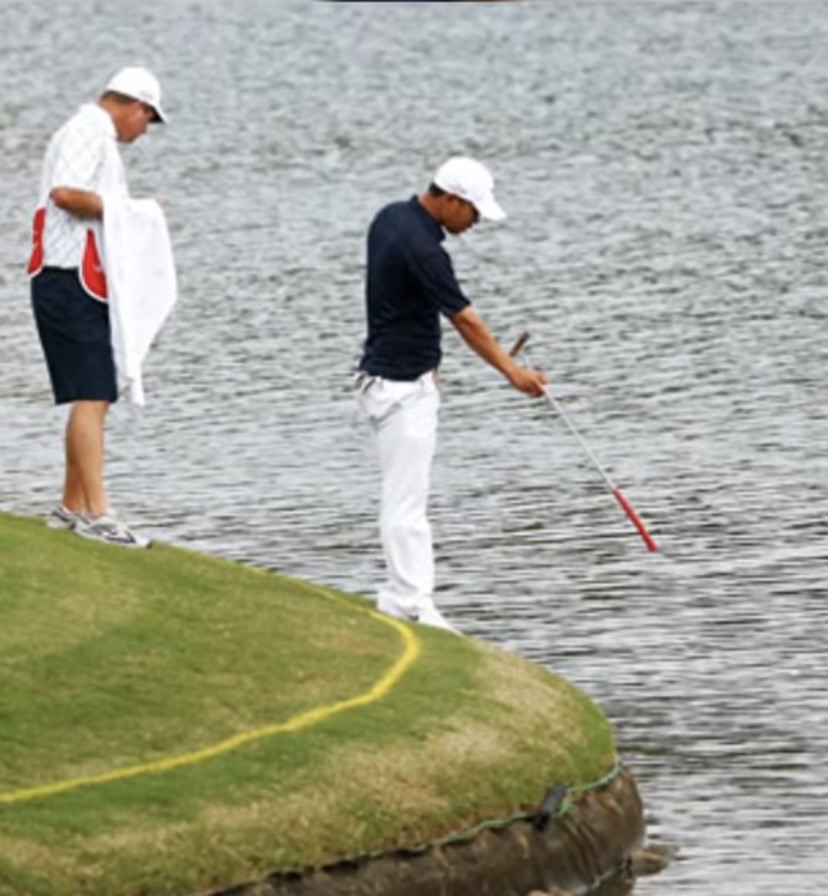
Golf, as some of us know, is a game of emotions and overcoming negative thoughts. One of the keys to this is to understand hazards on a golf course and how to avoid them or tackle them if the shot requires it. As Bobby Jones wrote “the value of a hazard is oftentimes more psychological than penal”. Or as Shakespeare put it “nothing is good or bad but thinking makes it so”.
We’ve already had a look at bunkers, now let’s look at water and trees.
Your perception of a hazard might be that escape from it will be difficult or impossible. But it’s all about shot making skills. It is rare that a situation is impossible to escape from and the only course of action is to take a drop and a penalty shot. These inescapable hazards are out of bounds, lakes, and the sea. Deep rough as we I wrote about in a previous post can be penal and cost you more strokes than taking a drop from water.
Work out the shot’s degree of difficulty. When a hazard must be carried the landing area must be your focus, not the challenge. Many golf course designers make holes look more difficult than they actually are. It may be less difficult than it appears
Most hazards will offer you several shot making options. To carry your ball over a pond look at the adjacent slopes running into it. Identify a target area that will give you a good subsequent shot – calculate accurate distances on the golf course and know how far you can reasonably expect to hit each club. Use a yardage book or laser measuring device, know how far you hit each club and look at sprinkler heads to see if distances are marked on them. If you have a lake to carry work out how far you are from the water’s edge, then calculate the carry across the lake to the front portion of the green. The total should provide you with a reasonable estimate of the distance you have to hit the shot.
When you practice work out your distances you hit each club. That will help you calculate your club selection on the course. This is a very important part of your game to know your individual skill in hitting each club. Work out your own club distance chart.
Hazards are placed to make the game more interesting, not to punish bad shots. The feeling of carrying a drive across an ocean and the achievement of landing the ball on the green is worth all the effort in learning how to work out distances.
Water Hazards
Water on a golf course can be lakes, ponds, rivers, streams, creeks, oceans or marshy wetlands. Look at the location, its angle with respect to the hole and its shape.
A water hazard may run parallel to the hole, cross it diagonally, curve around it, or sit at an angle. It may be near the tee or green, alongside the fairway, and can take many shapes. Occasionally a stream could cross a fairway at a right angle to the configuration of the fairway and green.
Water hazards are generally not neat; they are irregular haphazard forms. They may have inlets or other jagged features requiring a carry of several more yards than a smooth edged hazard.
Estimating distance over water can be deceptive because a large body of water may appear flat and shorter than it really is. Check the surrounding land to see if it is contoured so that balls landing there may turn into the hazard. The water hazard may be part of the course/s drainage system and be situated in a low area. If the land flows towards the hazard consider this factor when making your club selection.
When faced with a carry over water you must consistently be aware of your lie. One of the trickiest shots is hitting from a downhill lie across a water hazard. A bad lie forces you to be conservative. If you have a decent lie you can be more aggressive. Laying up might be the most sensible option if it gives you a good angle of approach for your next shot.
Water placed near a tee is a distraction. It may be well clear of a tee shot but will put doubt in a golfer’s mind. Water near a fairway may tempt you to play close to it to get a preferred angle of attack or a better distance for your next shot. The water here can capture poorly planned or executed shots. When water is placed across the fairway the designer is asking if you can play safely across or should you take a conservative approach and lay up short.
Water in front of a green is commonly used and is one of golf’s trickiest shots. Not only are you trying to clear the water but you must land and stop the ball on the green near to the pin. Make sure you select a club that will carry the hazard, with the least margin of error.
A good way to block out water in the front of a green is to focus on a feature behind it such as the edge of a bunker, a tree or a mound and play to a distance at the rear of the green. Features behind make for visual definition and shifting your attention to this area will make the water hazard secondary to your field of vision and thought process.
Water surrounding a green offers little room for error. It is sometimes found on short par 3s and on par 5s that call for a short approach shot. Calculate the distance to the middle of the green and aim for it. Shooting for a flagstick close to the water/s edge is the temptation. It calls for conservative strategy.
Consider the area between the edge of the water hazard and the putting surface. It may be a slope, mound, bunker, or flat ground. Allow for the extra distance from the water’s edge to the front of the green, and remember that if your ball finishes there, you may face deep rough.
This buffer zone is sometimes thick grass along a body of water. It may save a misplayed shot from going into the water and let you recover your score. On the other hands rocks, waste material and more penal rough won’t give you any help. Look for a little room for error to ensure carrying the hazard and the buffer zone.
One of the best recoveries from water in professional golf was when Seve Ballesteros, playing in the Masters, found his ball in Rae’s Creek on the par 5 thirteenth hole, partially submerged. After taking off one she he blasted the ball out and he made his par keeping his momentum intact and propelling him to winning the tournament.
Playing from Trees
Trees are not just a hazard, they can also be a safety barrier against errant shots. They can also help you with your shot selection by indicating the proper line or providing a backdrop for a green to help you calculate distances.
If you have a misaligned shot that hits a tree and you end up under or behind one of them then you are in an area of the golf course that you want to avoid.
But trees are three dimensional challenges, These vertical hazards often require a more complex shot selection if you plan to play over, under or through a tree or group of trees. You must not only select the proper line and calculate the distance but you must determine how you are going to shape your shot around the tree hazard. If there is a large tree inside a dog leg then you must calculate how much fade or draw to put onto the shot. So there is a third parameter to be worked in: line, distance and shape of shot. Assess the situation. Will you go over, under, around or through the trees?
When you are on the practice ground not only work out how far you hit each club but how high you hit them. Work out the trajectories and practice hitting right to left and left to right. This knowledge will help you successfully tackle the three dimensional challenge of tree hazards.
Small groves of trees can be used to guard any portion of a golf hole from the tee through to the green. A shot may be required over, under, around or away from them. Trees near a green may guard a corner of the putting surface. Look at how difficult it would be to escape from them should you find yourself in them.
Occasionally, a single tree will be in the landing area off the tee to make a tee shot tighter and requiring more accuracy. If the golfer gambles and hit nearer to the tree they may be rewarded with a shorter approach shot and better angle to the green.
Sometimes you will find a lone tree directly in the centre of a fairway at the landing area. Or a single tree may guard a corner of a green surface and make a portion of that green inaccessible from parts of the fairway.
Trees are growing and change height, width and shape due to pruning or storm damage or diseases. Changes in the trees, gradual or sudden, will change the strategic role they play on the course over time.
Water and tree hazards create varied challenges on the course. Managed well, they can help you protect your score, and understanding their purpose can guide smarter shot-making.

