
Successful chipping depends on judging distance well. The ball’s roll is shaped by your club’s loft and green conditions, such as moisture, slopes, contours, and wind. Consider these factors on every shot to build a reliable sense of how far each club will carry and roll.
Choosing the right club to play a chip shot is important. Use different clubs for different situations and lies. Let the club’s loft do the work rather than changing your swing.
Aim at a point on the green where you want the ball to land and let it run from there to the target. When you practice your short game try out these shots with different clubs to see how far the ball rolls.
Try to chip onto the green, the fringe and rough around it will cause the ball to bounce . Try to avoid landing the ball on slopes on the green. It’s hard to judge the angle of the bounce from these angles. Land the ball on the flat areas wherever possible. If you can, chip over severe contours and land the ball on flatter areas around the cup.
When you arrive at the ball, first check the lie. This will tell you what club to use. The worse the lie, the more you will need to play the ball back in your stance. Keep your hands ahead of the ball at impact to produce a more descending blow and solid contact,
Use a 7 or 9 iron from an uphill lie because of the loft the lie provides. Use a more lofted club (pitching wedge or 60 degree wedge) for a downhill lie which will take the loft off.
If the ball is in longer grass, hit the ball harder. Look at the grass. If the grass is shiny then the grain is with you, so swing easier. If the grass is dull the grass is down grain – against you, so hit it harder. Visualise the shot before you hit it. See the landing area and imagine how the ball will roll to the hole. Take a few practice swings to the side of the ball before you approach it, set up and hit your shot.
The Basic Chip Shot

Chipping is an important skill to help you score better. By practicing your short game regularly, you will develop feel for distance and how hard or soft to hit your shots. Feel the right distance and chose the right club. Try not to put spin onto the ball. This is because you want to make the ball easy to control and let it run on the green. Aim to make solid contact with a square clubface and let the face and the grooves do their job. If you close the clubface you will make the ball run more. Open it and you will make it fly up. You want to have a consistent approach to chipping.
If the fringe is firm, consider using a putter. Otherwise, choose anything from a wedge to a 7 iron, depending on the lie. Do not limit yourself to one club when several options may suit the shot.
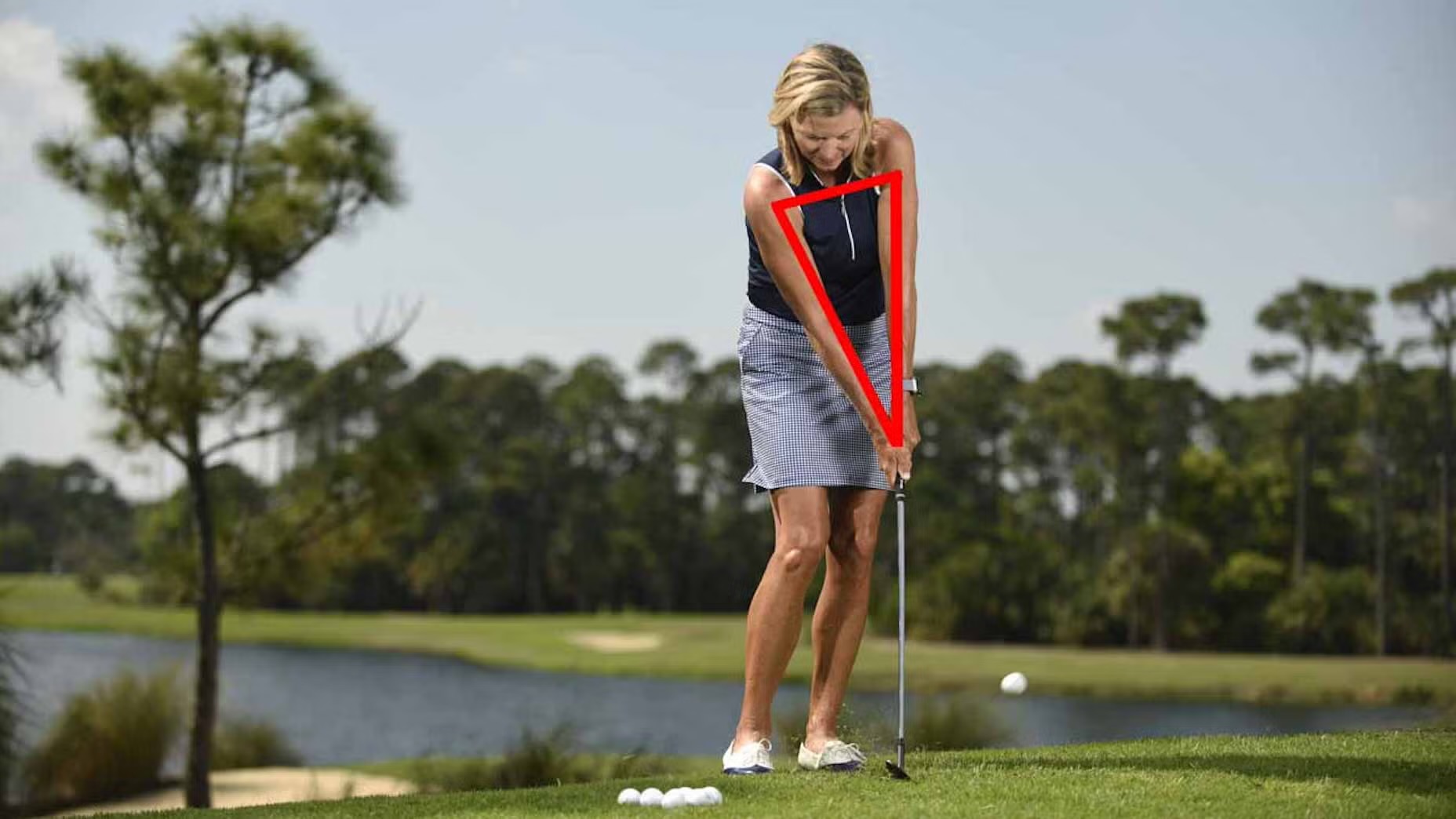
As you address the ball in a chipping stroke your hands should be ahead of the ball and your stance should be slightly open. The left arm leads with firm wrists through impact. Keep your lower body quiet but with flexed knees.
Most of your weight will be on your left foot. With qn open stance you will accelerate your club through the ball. If you have a poor lie position the ball slightly further back in your stance for a more descending blow. Hands ahead of the clubhead at address.
Grip down on the club for better control when chipping, and use the same approach with each club. As you swing, lightly brush the grass with the sole of the club and sweep the ball away smoothly.
Use a rocking movement in the shot. Swing back and then rock forward with the right knee going towards the target. The left arm leads the forward swing through.
When the ball lands, watch how the grain of the green affects your chipping. If the grain is against you, you’ll have to swing harder. If it’s with you, you’ll have to swing easier. If the grass is shiny the grain is with you and the ball will roll further. If it is dull it won’t roll further as the grain is against you. If you’re chipping downhill and the slope looks light coloured you’ll need to swing easier.
Be aware that the wind will affect chip shots. Of you loft the ball in the air in a strong crosswind, the wind will work on it. When the ball lands it will land at an angle and move sideways.
If you are just off the green on firm, dry, closely cut fringe, use a putter rather than chipping.
Uphill, downhill and sidehill lies
To play a short shut from one of these eyes you should alter your body position and club selection.
From an uphill lie lhe slope will add loft to the club. This may make you hit the ball too high. It will make distance more difficult to judge. Choose a less lofted club like an 8 iron. Align your body to the slope with your weight toward the right and play the ball more towards your left foot. This will allow you to swing along the slope.
From a downhill lie the ball will fly lower. Choose a 60 degree wedge or a sand wedge and play the ball back in your stance. Set your weight on your left side. Align your body with the slope to swing with it. The ball will roll further from a downhill lie so take that into account.
From a sidehill lie be aware that the ball will fall in the direction of the slope.
When the ball is below your feet your more upright swing will cause sidespin, which makes the ball fly from left to right. To counteract this stand closer to the ball with body weight forward and to the left.
With the ball above your feet, the shot will tend to be pulled left of the target because of the flatter arc of the swing. Stand further away from the ball and play it more towards the back of your stance. Set your weight to the left but more on your toes to retain balance. Grip down on the club, aim to the right and swing with the slope. Swing harder on this shot to compensate for the shorter arc that results from gripping down on the club. Aim well right and swing with the slope. Swing harder to compensate for the shorter arc that results from gripping down the club.
Bump and Run Shot
Playing on a links course it is useful to play this shot, especially in windy conditions. Use this shot when it’s difficult to get a lofted shot near the hole. Take a lofted club, perhaps a 7 iron and chip the ball into the upslope so it bounces up to the top of the mound and then runs down the other side of the green. Have the ball running smoothly down the slope.
Chipping from a bare lie
The important thing is to position yourself so you can contact the ball first, just left of centre. Hit the ball with a downward strike. Hands re positioned ahead of the clubhead and swing normally. Use a pitching wedge rather than a sand wedge for this shot.

